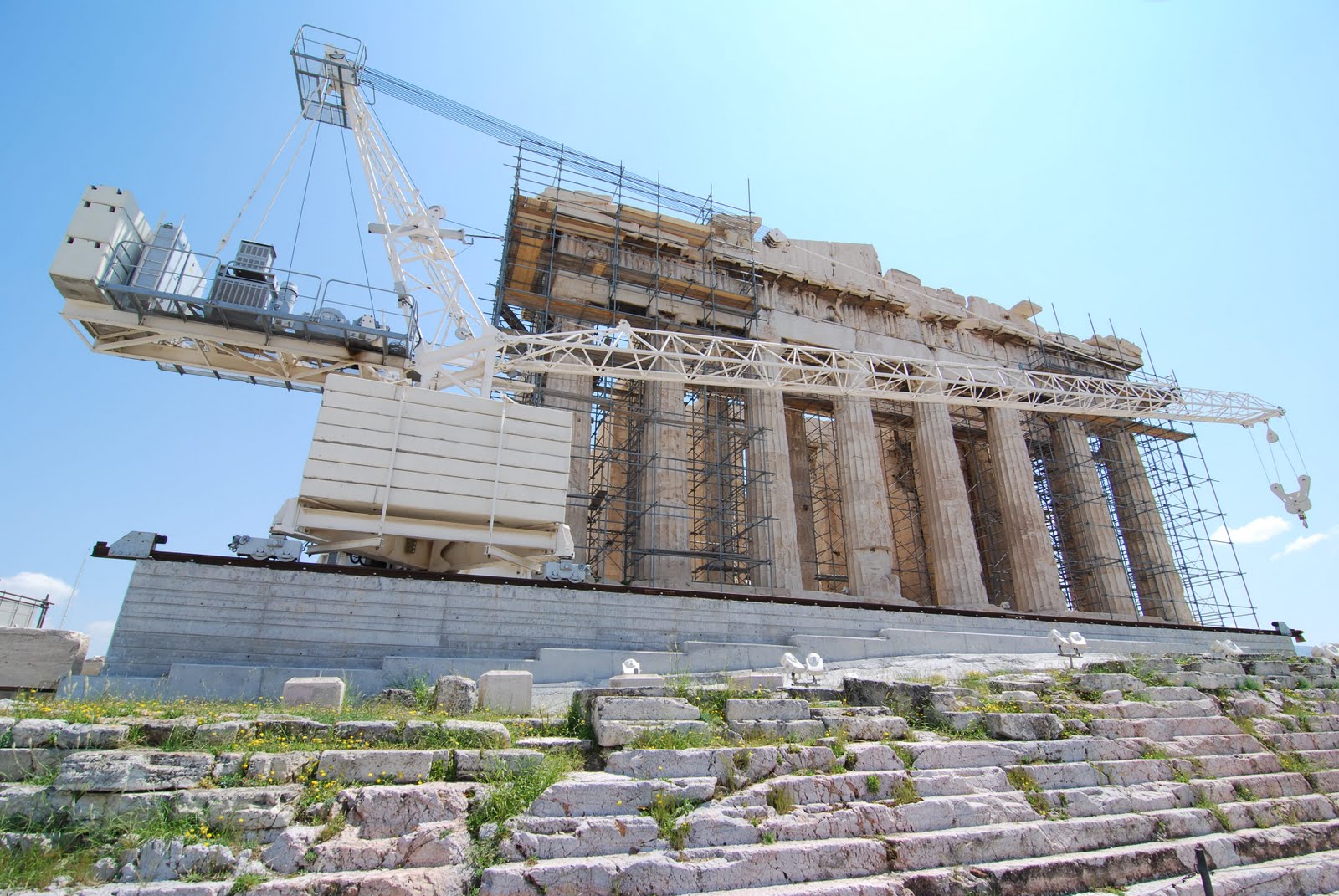
This being my third or fourth visit to the Acropolis, one would assume that little could have changed about the site itself. One would be wrong in assuming this, however, as the Acropolis site is one of the more fluid archaeological sites I've ever visited. It helps that my time scale is measured in years rather than moments, but despite the glacial pace, even the Parthenon is under constant construction and restoration work. I won't go into the historical or archaeological details except to say that 2400 years of combined pollution, weather, and 'restoration' work their wonders on even the stoutest of marble structures.
This time around the North side of the building was no longer scaffolded, which is fortunate, since it is the largest side that visitors have enough space to get a really good view of. My previous visits in 2009-10 gave me a really great view of a crane and associated peripheral equipment, with a bit of Parthenon peaking out between the cracks. Only the smaller East and West sides had been visible--now it is the West that is covered (which is also disappointing, as it is the first side visible from the Propylaea. I am sure the restoration works will be well worth the time, but 40 years of constant construction is quite a long time, especially considering that with relatively primitive tools the building and its sculpture were completed in around 16.
My slightly better knowledge of the building and architecture in general since my last visit did actually add quite a lot to my ability to appreciate what I was seeing in person. Of course one needs none of these to know that the Parthenon is beautiful; to see why it is beautiful is another thing altogether. The architectural refinements really do seem to work some kind of strange magic. In this sense I think the building's incompleteness is something of an asset (although simultaneously a great shame).
Just down the Acropolis is the Bathhouse of the Winds site, interesting to me because of a strange 8 sided structure in one corner depicting the 8 winds of ancient mythology. I know extremely little about this building, as the plaques were not particularly useful, and information is relatively difficult to find online. Surprisingly the site is also home to a mosque, built during Ottoman times, and now disused. Its exterior could pass for a Byzantine church, which I had assumed it was from my first visit to Athens. In fact, I sketched the door of the medrese the day I left Athens in 2010 and labeled it as a church door. Looking closely at it today, I see an Arabic inscription above the door--I'm not sure how I missed that before, after having stared at it for 3 hours.
Further down from the Acropolis is the heavily restored Stoa of Attalos the Second. This was the largest building in the Agora, and was originally built about 200 years after the Parthenon. It would have served as a marketplace and common area at the time; the restored building serves as an Agora museum. Much longer than wide, it's got the most impressive colonnade in Athens, outside the Parthenon. We didn't actually go in; but there was an impressive sculpture collection in the portico which we did spend some time exploring.
Finally, the Acropolis Museum once again shared its secrets, this time at a slightly more expensive rate than before. Although again my Art History 101 class came in quite handy, as I find myself more familiar with sculpture and the history behind it than I ever was before. Between the Archaeological Museum and the Acropolis Museum, few of the major sculptures I've seen photos of have been left unseen in person--although unfortunately the Acropolis Museum does not allow me to share via photograph. A short list of famous objects in this museum includes the Caryatids, Kritios Boy, and the Peplos Kore.
Being in the middle of such an abundance of both natural and manmade beauty is something that is easy to become numb and spoiled to, even over the course of less than a week. After the first 5 or 6 really famous statues and 50-60 less famous but still beautiful ones, it becomes harder and harder to really appreciate each one for what it is--a truly stunning piece of both creativity, history, and workmanship. This is exacerbated by the fact that museums concentrate centuries worth of sculpture and architectural detail into small spaces, compressing both time and context into something visitors can see in a single day but that does not allow each piece to really shine. It takes a truly unique or truly outstanding piece (sadly this often means only 'most intact' or 'most well-written about') to catch one's eye and draw a crowd. The Acropolis museum has perhaps 2 dozen kore/koroi on a single floor, several of which rival the Peplos Kore, but most are scanned and then passed by visitors.
I think this is the true challenge of travel, and what most 'tourists' get wrong. There are two ways to make sure that numbness doesn't set in--either narrow your focus to one time period or subject (how on earth can one person become intimately familiar with Archaic, Classical, Neoclassical, Byzantine, Ottoman, and Mycenean art, culture, and history in the space of one lifetime, much less one trip?) or learn to aesthetically appreciate an object in the strictest sense of the term. I think this may be the harder method, as it requires concentration and the ability to let go of the desire to 'know something' about the subject, and requires instead a sort of pure examination of form. This is what I am trying to do, although I am mostly failing. I want too badly to 'know something' about each of the objects that I find myself playing detective with the features. I have managed to slip, unnoticed, into a purely aesthetic appreciation of several things this trip, which is an amazing number by any count, but clearly I still have room for improvement.
Enough inane ranting, and on with the part most will skip to anyway--the photos.